My stepfather demanded I pay for his daughter’s new house — but what he didn’t know was that my mother had been hiding a 19-year
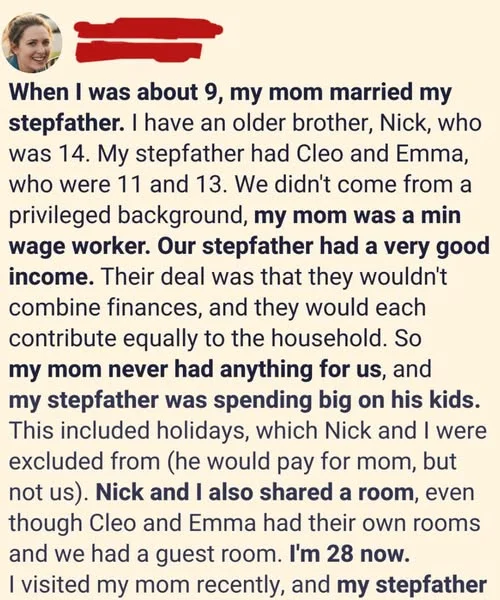
Growing up, I watched my stepdad book plane tickets and beach resorts for his daughters while my brother and I stayed home, pretending we didn’t care. We were part of the household, but never truly part of his plans. I convinced myself I had outgrown that chapter of my life—until the afternoon he called to ask me for $25,000 to help his daughter buy her first house. My biological father left when I was seven. One day he was there; the next, he wasn’t. No long goodbye, no explanation that made sense to a child. My mom was suddenly alone with two kids—my older brother Nick, who was twelve, and me. Nick tried to act tough about it, but I remember hearing him cry behind his bedroom door at night. I didn’t understand the mechanics of divorce. I only understood absence. “Mom, why did Dad leave?” I asked once, curled beside her on our sagging couch. She stroked my hair gently. “Sometimes adults make choices that hurt people,” she said softly. “But we’re going to be okay.” She meant it. She always meant it. But okay was a generous word. Mom worked whatever jobs she could find—cashier shifts, cleaning offices at night, waitressing double shifts on weekends. I remember standing beside her in grocery store lines while she calculated totals in her head, quietly removing items from the cart if the number went too high. There was always a clear line between what we needed and what we wanted. Needs won every time. Two years later, Liam entered our lives. I still see that afternoon clearly. Mom stood in the living room, smoothing her blouse over and over again, nervous in a way I hadn’t seen before. “Kids, I’d like you to meet someone,” she said. Liam stepped forward with an easy smile and salt-and-pepper hair that made him look stable, dependable. “Hi there,” he said warmly. “You must be Nick and Stacey. Your mom talks about you nonstop.” Nick muttered something under his breath—he was in that phase where enthusiasm felt illegal. I studied Liam carefully. He made my mom laugh. That felt important. What I didn’t realize then was that Liam didn’t come alone. He had two daughters from his previous marriage—Cleo, eleven, and Emma, thirteen. When Mom married him, our quiet trio became a blended household of six. At least that’s how it looked on paper. In reality, we lived parallel lives under one roof. Not long after the wedding, Mom sat Nick and me down at the kitchen table. “We’ve agreed to keep our finances separate,” she explained. “Liam and I will each pay half of the household expenses.” It sounded responsible. Balanced. Mature. But fairness on paper isn’t always fairness in practice. Mom was still earning close to minimum wage. Liam, on the other hand, had a comfortable, steady income. “Half” meant Mom continued scraping by to cover her share of rent, utilities, and groceries. “Half” meant Liam paid the same amount—but had plenty left afterward. And that extra money didn’t disappear quietly. It showed up in new phones for Cleo and Emma. In name-brand sneakers. In birthday parties held at skating rinks instead of our backyard. It showed up most clearly in vacations. One morning at breakfast, Cleo practically glowed with excitement. “Dad’s taking us to Disney World!” she announced. Emma beamed. “We leave in two weeks.” I remember staring at my cereal, pretending it didn’t sting. Nick shrugged like it didn’t matter. I knew better. We weren’t invited. Not because of scheduling conflicts or space limitations. Simply because we weren’t his responsibility in that way. Mom tried to soften it later. “It’s their tradition,” she said gently. “They’ve always gone together.” But traditions can be built. They can also be chosen. And we were never chosen. Over the years, I learned to lower my expectations. I told myself it didn’t matter. I focused on school. On getting out. On building a future where I wouldn’t have to measure my worth against someone else’s daughters. Eventually, I left home, built a career, and created stability for myself. I carried those childhood feelings quietly, like old bruises that no longer hurt unless pressed. I thought I had made peace with it. Until decades later, when Liam called and said he needed $25,000—to help Emma with a down payment on a house. And suddenly, every Disney vacation, every unspoken comparison, every “equal” contribution came rushing back like it had happened yesterday. “That’s nice,” I said, assuming we were all going. “Just us girls and Mom,” Emma added, giving me a look that made it clear I wasn’t included. Mom shifted uncomfortably. “Liam thought it would be nice for him to have some special time with his daughters.” “What about us?” Nick asked. “Well, maybe next time,” Mom replied weakly. But next time never came—for us, anyway. That became the pattern. Liam always paid for Mom to join their family trips, while Nick and I stayed home with whatever relative was available to watch us. But the vacations weren’t even the worst part. It was living every day in a house that constantly reminded us that we were second-class. Cleo and Emma had their own bedrooms, complete with matching furniture and carefully decorated spaces. Nick and I shared a cramped room with bunk beds—even though the guest room stayed empty “for when Liam’s parents visit.” “This isn’t fair,” Nick would whisper from the top bunk at night. “I know,” I’d whisper back, staring at the ceiling. “But what can we do?” We learned to live with less. We learned that love came with conditions. And we learned that “family” didn’t always include the people who lived under the same roof. Years passed, and somehow we all grew up despite everything. Nick left for college at 18. I remember him packing his beat-up duffel bag. “I’m … Read more
