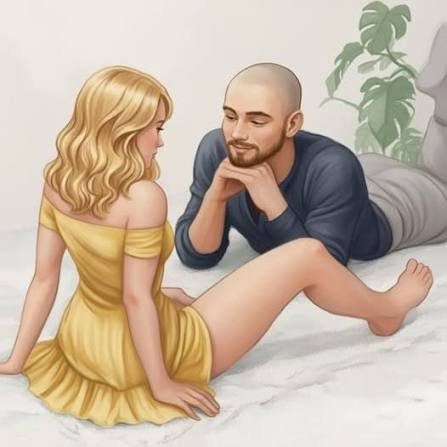
There’s Finally An Answer To Why Men Prefer Short Girls Or Tall Girls..See More>

When you’re looking for a woman to date, the list of qualities to consider can seem infinite. There’s hair color. Skin tone. Style. Every guy has his own preferences, and these influence whom he dates. But it’s particularly hard to ignore one asset — a woman’s height. Height is often the first thing you notice about someone when you first meet. You’ll estimate a woman’s height as soon as you approach her. You’ll notice it when you first make eye contact, you’ll be aware of it the first time you hold her hand, and you’ll certainly pay attention to it the first time you’re in bed together. Whether you’re into tall women or petite ones, no type is universally superior. That said, it would be wrong to deny that individual guys have their own preferences. While some dudes might not even include height when considering the qualities they desire in a woman, others put a great deal of emphasis on how their potential partners measure up (pun intended). If a guy is short and insecure, he may compensate for his height by seeking out a shorter woman. But if a guy is short and resourceful, he might pursue a taller woman. He might help a woman find her car in a crowded parking lot. Maybe he’ll offer to reach for the top shelf at Whole Foods. OK, I was kidding there — but, point being, there are pros and cons to a man’s own height in seeking a partner. If you were wondering why you’ve been singularly attracted to tall or short women in particular, science may reveal the deeper meaning behind your “type.” Here’s what the research has to say. Choice A: Tall Women There’s a reason why the world’s finest designers model tall women. The fashion world sets up tall, slender women as the “ideal” type. In response, women around the world buy high-heeled shoes (and ignore the discomfort) in order to gain a few inches. Tall women attract attention. When a group of women walk into a bar, most eyes turn immediately to the tallest one in the group — simply because she might be the first face they see. And when men interact with tall women, as Roger Dobson explains for The Independent, the outcome is generally positive. According to Dobson, “both men and women judge a tall female on first sight as more intelligent, assertive, independent and ambitious.” Dobson further explains that men view tall women as being wealthier and more successful. These initial impressions don’t guarantee a lasting relationship. But they do give tall women a leg up (no pun intended). Although these judgements may seem superficial, I understand where they come from. Whenever I think of a tall woman, I almost always picture Uma Thurman or Maria Sharapova — tall, blonde, alpha females. Both happen to be very assertive. And while I wouldn’t expect every tall woman to be as strong-willed as the two I just mentioned, stature can indicate personality. Dobson explains that men make many conclusions about a woman based on her height. Psychologists from the Universities of Liverpool and Central Lancashire set out to gain a better understanding of height discrimination, a tendency that has influenced male-male competition since the beginning of human history. But heightism is not confined to ego battles between men. It also plays a large role in a man’s choice of mate. In one study, men were asked to judge the characters of women whose pictures had been digitally shortened or lengthened. These findings served as “the first direct evidence that female height influences perception of their character,” Dr. Simon Chu, who was involved in the study, explained. Choice B: Short Women The evidence found in studies of heightism is not entirely in favor of tall women. In fact, it often suggests that men may view shorter women in an equally positive light. While men might see taller women as more conventionally attractive — and even more intelligent — than shorter women, men find the latter to be “more nurturing and likely to be better mothers.” According to Dobson, “men believed that shorter women were more considerate, nurturing and homely.” This conclusion could come an initial belief that short women are not intimidating. Many shorter men have to conquer the fear of dating women who are taller than they are. Many men might find taller women more imposing — and smaller women more inviting. In a Daily Mail report, researchers suggest “small women with long legs” are empirically the most attractive “type.” According to the man behind the claim, Dr. William Brown of Brunel University, “shorter, slimmer females with long slender limbs and larger breasts are more attractive.” Dr. Brown explains his logic through the concept of body symmetry. Though tall, slim, women may appear thinnest on a runway, it’s the shorter, curvier women who are most symmetrically pleasing. Ultimately, height is just a number. But your choice of a tall or a short woman could reveal which other qualities attract you. If you’re a lad who fancies taller women, you might prefer a more independent and assertive companion. If you are a shorter man, you could be seeking out someone more nurturing.

IF your dog is sniffing your genital area, it means you have…See more

Dogs have an incredible sense of smell and use it to learn about the world, including the people they live with. When a dog sniffs your private area, it’s not being rude—it’s just gathering information. That part of the body has many sweat glands that release pheromones, which dogs can detect through a special organ in their nose. Your dog might be sniffing your groin because it senses hormonal changes, like during menstruation, pregnancy, or ovulation. Dogs can even detect infections or medical conditions like diabetes or cancer before tests can. They also pick up on emotional states such as stress or fear, which produce changes in your body odor. While this behavior is normal, it can be embarrassing. If it bothers you, you can train your dog to stop by using commands like “leave it,” redirecting its attention, or encouraging it to sniff your hand instead. Keeping yourself clean and calm during greetings also helps reduce the urge. In rare cases, excessive sniffing might mean your dog is sensing a health issue. If your dog suddenly becomes fixated on your private area, it might be worth checking with your doctor. But in most cases, it’s simply your dog’s way of saying hello and checking in.

They locate the body of the young daughter of… See more

At sixty-two, I never imagined I’d end up sleeping on the sofa bed in my own son’s living room. My whole life, reduced to two suitcases and a handbag. The divorce papers were still hot from the lawyer’s printer when Marvin, my only son, offered me what he called “a temporary solution.” Temporary. As if the collapse of a thirty-year marriage were just a passing inconvenience. The morning light filtered through the pristine white curtains of Dorothy, his wife, casting shadows on the wooden floor I couldn’t walk on with shoes. Every rule in that house was unspoken but absolute: don’t use the good towels, don’t touch the thermostat, don’t cook anything that would smell. I had become a ghost, haunting the edges of a perfect life that wasn’t mine. “Mom, you’re up early,” Marvin appeared in the kitchen doorway, already dressed in his charcoal gray suit. At thirty-five, I had inherited my father’s firm jaw and my stubbornness, although I seemed to have forgotten where the latter came from. “I couldn’t sleep,” I replied, making instant coffee with water heated in the microwave. The proper coffee maker was off-limits: “It was a wedding gift,” Dorothy explained with a forced smile. Marvin shifted nervously, like when he was a kid and had to confess something. “Dorothy and I were talking,” he began. “We think maybe you should start looking for something more… permanent.” The coffee turned bitter in my mouth. “Permanent arrangements? ” “Retirement homes. They have excellent programs now.” “Sure.” I slammed the cup down on the table harder than necessary. “How silly of me to think I could stay here until I could walk again.” “Don’t be like that. You know we want to help you.” “Help me?” The word came out sharper than I intended. “Marvin, you took Dorothy’s mother to see that new apartment complex on Maple Street yesterday. The one with the granite countertops. Her Adam’s apple bobbed up and down. ” “That’s different. Her mother has specific needs.” “My specific need is a  bed that isn’t your couch.” Dorothy appeared then, her blonde hair pulled back in a neat bun. She moved around the kitchen with studied efficiency, avoiding my gaze. “Good morning, Martha,” she said without looking up. The use of my full name was a constant reminder that I wasn’t family, but a guest who had overstayed her welcome. The spare room, which they used for storing boxes, had been emptied and painted a soft yellow the week before, preparing it for their first child. Dorothy was barely showing, but they had already started shopping for cribs. “Dorothy needs the space to get the nursery ready,” Marvin explained. “She’s been very stressed.” “I didn’t suggest staying there forever, Marvin. Just until we find somewhere else.” Dorothy finally looked at me, her green eyes cold and calculating. “Martha, I don’t think you understand the point. This is about boundaries. About what’s appropriate.” “Appropriate?” I repeated. And what would be appropriate for a woman whose husband of thirty years left her for his secretary? “Mom, no… ” “Marvin, let me get this straight. Does your unborn child need his own room more than your homeless mother needs a bed? Is that right?” The blood drained from Marvin’s face. “You’re not homeless. You have options. Dad offered you the apartment in Florida.” “Your father offered me a one-bedroom apartment 2,000 miles away, only if I signed away half my estate. Very generous.” The whir of Dorothy’s blender drowned out any reply. When the motor stopped, the silence was heavier. “If you wanted comfort,” Marvin said finally, in a low voice, “you should have stayed married to Dad.” The words hit me like a punch. I looked at my son, the man I had raised, fed, and loved unconditionally, and saw a stranger. “I see,” I said, setting the cup in the sink. “Thanks for clarifying my place here.” I spent the day looking for rentals on my phone, recalculating my meager savings. I had exactly 847 dollars in my account. At 62, jobless and creditless, that was like having eight cents. That evening I went to the corner store. At the register, I stared at the lottery ticket display. The Powerball was at 300 million. I heard myself say, “A quick pick, please.” Mr. Patel put the ticket in the machine. A rectangular piece of paper popped out: 7, 14, 23, 31, 42. Powerball 18. “Good luck,” she said, handing me my change. Eight dollars. All I had left. The apartment was empty when I got back. A note on the counter: Marvin and Dorothy had gone to her mother’s for dinner. Of course. I settled on the  couch and turned on the news. At 11:17 p.m., the lottery numbers appeared on the screen. 7, 14, 23, 31, 42. Powerball 18. I stared at the TV, convinced I was hallucinating. I pulled out the ticket with trembling hands and checked the numbers again and again. They all matched. The ticket fell to the floor as I sank into the cushions. Three hundred million dollars. After taxes, enough to never sleep on anyone else’s couch again. Enough to look my son in the eye and tell him exactly what I thought of his “tough love.” The question wasn’t what he would do with the money. The question was what he would do with the power.

.Women’s who have a vag…See more

Why does my girlfriend like shaving her pubic hair and armpits? Because that’s how she prefers to maintain her body hair. Some women like it, some women don’t. Personally, I remove my armpit hair because I like to wear tank tops and other sleeveless fashions and I think armpit hair is unattractive. It’s all about looks. I remove my pubic hair because I found I prefer the increased sensitivity it gives me when it comes to sexual activities. It’s all about feel. I have to admit I was startled at my prepubescent “little girl” appearance the first time I looked in the mirror after shaving it off but that was years ago and I’ve gotten used to it. In this day and age, it seems to me it’s become more the norm than having pubic hair. I do think an unruly bush is very unattractive and nobody wants to see your pubes peeking out around your bikini. IMO, it should be nicely trimmed to at least a half-inch or less. So it’s about looks too. Shaving the pubic area and armpits is a personal grooming choice with no inherent meaning. It’s a cosmetic preference, and women shave for various reasons, including hygiene, comfort, and aesthetics.  Here’s a more detailed explanation: Personal Hygiene: Some women find that shaving makes them feel cleaner, as it eliminates hair that can trap odors or sweat.  Comfort: Shaving can be a matter of comfort, as some women find the feeling of smooth skin more comfortable, especially during activities like swimming or wearing certain clothing.  Aesthetics: Shaving is a common beauty practice, and many women choose to shave to achieve a desired look, often influenced by cultural norms and media portrayals.  Sexual Attraction: Some women may shave to feel more attractive or to meet the perceived preferences of their partners.  No inherent meaning: It’s important to remember that there is no single meaning to shaving one’s pubic area or armpits. It’s a personal choice with no inherent connection to cleanliness, sexual availability, or any other specific characteristic.  Ultimately, whether or not a woman chooses to shave is a personal decision with no universally accepted meaning.

20 Minutes ago in Los Angeles , Malia Obama was confirmed as…See more

Malia Obama, the eldest daughter of former U.S. President Barack Obama and former First Lady Michelle Obama, is stepping into the spotlight in a new way. The 25-year-old is making strides in the entertainment industry and recently made headlines for choosing to use a different name professionally. Los Angeles tourism Malia made her directorial debut at the prestigious Sundance Film Festival with her film, The Heart. While her creative talents were widely recognized, what caught the public’s attention was her decision to drop her famous last name from the credits, opting to go by “Malia Ann.” Born as Malia Ann Obama on July 4, 1998, her middle name honors her paternal grandmother, Ann Dunham. Malia has always been known for her intelligence, grace, and artistic inclinations. Despite growing up in the public eye and attending Harvard University, she has chosen to forge her own identity in Hollywood, independent of her family’s political legacy. First Lady insights Stepping into Filmmaking Malia’s passion for storytelling has been evident for years. She made her entry into the entertainment industry in 2021 as part of the writing team for Swarm, an Amazon Prime series featuring notable stars like Billie Eilish and Rory Culkin. Her talent was quickly recognized by industry professionals. Janine Nabers, co-creator of Swarm, praised Malia’s creativity and dedication, telling E! Online, “Some of her pitches were wild and incredibly creative. She’s an amazing writer and brought so much to the table.” Similarly, Swarm executive producer Stephen Glover emphasized that she earned her place on the team through hard work and not because of her last name. “We can’t treat her any differently just because of who she is. She’s down to earth and very talented,” he told Vanity Fair.

BE CAREFUL, if you notice this in your underwear, it means you have…see below 050

Sarah Mitchell stared at the familiar pair of dark gray panties laid flat on her bathroom counter in Skopje the distinctive lighter whitish-brown bleach-like stains concentrated in the crotch area had appeared again more noticeably this time after only two days of wear. Like countless women before her she had always wondered about these mysterious marks that seemed to lighten the fabric as if someone had spilled actual bleach there but the truth she was about to uncover would completely change how she viewed her own body and bring comfort to millions of women worldwide who had quietly worried about the same thing. When she posted a discreet photo of the stained underwear alongside the small cluster of smooth pearl-like vaginal beads she sometimes used the response online exploded into a global conversation that eventually reached gynecologists and researchers who confirmed what the stains really were and why they appeared so consistently. The phenomenon known as vaginal bleaching of fabric is caused by the natural acidity and enzymes in healthy vaginal discharge interacting with the dyes in underwear creating those characteristic lighter patches that many women mistake for poor hygiene poor laundry habits or even signs of infection. Far from being something to hide or fear these marks turned out to be quiet evidence of a balanced vaginal microbiome working exactly as nature intended and the discovery brought relief and even empowerment to women who had silently felt ashamed of their bodies for years. The journey toward understanding began when Sarah decided to consult her gynecologist after years of switching to darker underwear colors and using extra laundry boosters in futile attempts to eliminate the stains. During her appointment Dr. Elena Petrova a leading women’s health specialist in the region examined the underwear photos and explained that the lighter areas result from the natural pH level of vaginal discharge which typically ranges between 3.8 and 4.5 being mildly acidic enough to gradually break down fabric dyes especially on cotton and synthetic blends. This process is completely normal and occurs more prominently in women with healthy estrogen levels and active cervical fluid production. The small pearl-like beads Sarah mentioned were actually vaginal moisture pearls designed to support lubrication and many women reported noticing stronger bleaching effects when using them because they help maintain optimal vaginal moisture. Dr. Petrova shared recent studies from European medical journals showing that women who regularly see these bleach marks tend to have lower rates of bacterial vaginosis and yeast infections because the same acidic environment that lightens fabric also protects against harmful pathogens. Sarah left the clinic feeling lighter than she had in years realizing that what she had viewed as an embarrassing flaw was actually a visible sign of her body functioning properly. Word of her consultation spread quickly through women’s health forums where thousands began sharing their own experiences turning the conversation from shame to scientific curiosity and prompting several universities to launch larger studies on the topic. The broader cultural impact of this discovery reached into classrooms medical textbooks and even advertising campaigns. Sex education programs in several European countries began incorporating sections about vaginal bleaching of fabric as a normal bodily function helping young girls enter adulthood with less shame and more knowledge. Gynecologists reported a noticeable increase in women seeking routine checkups rather than waiting until problems arose because they felt more comfortable discussing their bodies after seeing the widespread conversation online. Researchers continued exploring potential applications of the natural acids produced by the vaginal microbiome including developing new eco-friendly fabric treatments and even medical therapies for skin conditions. The small pearl-like beads gained popularity as wellness products with improved formulations designed to support rather than disrupt natural pH balance. Women who had previously thrown away expensive underwear every few months now celebrated the marks as badges of good health saving money and reducing waste. Sarah received countless messages from grateful followers who described how learning about the science had improved their self-esteem intimate relationships and overall confidence. The phenomenon that once caused silent embarrassment had become a powerful symbol of female bodily autonomy and the importance of listening to rather than fighting against natural processes. Years after her initial discovery Sarah looked back with gratitude at how a simple observation in her laundry basket had sparked such meaningful change in her life and the lives of so many others. The bleach spots in women’s underwear once a source of confusion and shame had been transformed into a celebrated indicator of wellness and balance celebrated openly in women’s health communities and supported by solid medical research. She continued her advocacy work while raising her own daughter with the knowledge and confidence she wished she had possessed earlier in life. The scientific community kept studying the vaginal microbiome discovering new connections between its health and everything from immune function to mental wellbeing. What began as one woman’s quiet question about stains on her panties evolved into a worldwide movement of body positivity education and scientific appreciation for the remarkable intelligence of the female body. Sarah’s favorite pair of gray underwear with its characteristic light patches now hung framed in her home office as a reminder that sometimes the most ordinary things carry the most profound lessons. Women everywhere learned to look at those familiar marks with pride rather than embarrassment understanding that their bodies were working exactly as they should be one natural bleaching cycle at a time.

If your partner asks you from behind, it’s because… 012

Why does my boyfriend only want to have sex with me from behind? Well, rear entry/doggie style sexual intercourse is a position that obviates eye contact, and thus a certain level of intimacy with your partner. You’re fucking, not necessarily “making love”. There is nothing wrong with that. Your boyfriend, however, is fixated with this position to the exclusion of all else in bed, you say. I can’t come up with a physical reason why no other position would work for him. I can, however, come up with some other reasons. He is not into or fearful of physical intimacy. Being inside your vagina is, of course, intimate. But I truly believe that kissing and eye contact are perhaps even more intimate. I’ve been with partners who did not enjoy or want to kiss, lingeringly or not, though it’s been quite rare. It was an immediate turn-off to me inside and outside the bedroom, and any prospect of an intimate relationship beyond just being fuck buddies or friends with benefits was off the table from my perspective. For a booty call, they may suffice…but I’m wired a bit differently. If all they wanted was PIV sex without the attendant making out and locking of lips, being held lovingly and passionately, embraced in a romantic and affectionate position – I’m not their man, and not just for that occasion. I’ve heard from quite a few women over the years that their previous partner was all about the doggie style sex. They kissed out of obligation, not passionate desire. I don’t think it was a coincidence that more than a few of these men are now in gay relationships. I hope they’re happy and feel unburdened not having to reluctantly cater to their previous partner’s heterosexual needs when they themselves are most homosexual than not. Of course, it doesn’t automatically mean your lover is disinclined to being sexual with women and wants to get it on with men instead. And here, dear OP, is the part that is hard for me to write: it may be you. Not that there is anything wrong with you – in bed and out – but he does not feel genuine emotional intimacy toward you, regardless of your feelings for him. Or perhaps he doesn’t know how to express those feelings, and so he indulges only in sexual positions that do not cater to emotional connection via kissing and eye contact. How affectionate is he outside the bedroom with you? Do you two kiss at all? Do you two share activities and interests? Is he invested in you as much as you are into him? If so, how does he express his love and interest in you as a partner and lover? Great sex does not mean you have a great relationship overall. But disengaged and perfunctory sex does mean you have problems with emotional and physical connection. Is it worth it to work through such issues? Only you can answer that. You two need to have a heart-to-heart discussion. You need to confirm you’re both on the same page as far as your individual needs, wants, and desires. You need to confirm you both agree to let each other know if these needs, wants, and desires shift or otherwise change in terms of variety, intensity, or frequency. You need to confirm that you two both are invested enough with each other before doing the hard work of repairing a relationship that no longer works for one or both of you.

The right image depicts a tick bite on the back of a person’s neck, with the tick still partially attached. Proper management of a tick bite involves:…See More>

Tick Identification & Bite Management The left image shows an engorged tick, likely after feeding on blood. Ticks are external parasites that belong to the arachnid family and are known for transmitting diseases such as Lyme disease or tick-borne encephalitis. The right image depicts a tick bite on the back of a person’s neck, with the tick still partially attached. Proper management of a tick bite involves: 1. Removal: Use fine-tipped tweezers to grasp the tick as close to the skin as possible and pull upward with steady pressure. Avoid twisting or jerking the tick. 2. Cleaning: Disinfect the bite area with soap and water or an antiseptic. 3. Monitoring: Watch for symptoms like rash, fever, or joint pain in the days and weeks following the bite, which could indicate infection. 4. Medical Attention: If the tick was attached for >24 hours or if symptoms develop, consult a healthcare professional for evaluation and possible testing for tick-borne illnesses. Prevention Tips – Wear protective clothing and use repellents in tick-prested areas. – Perform regular body checks after outdoor activities to spot ticks early. – Remove ticks promptly to reduce disease transmission risk.

The Vatican trembles. The secret has come to light…

The seals have been broken. The silence has shattered. And what lay hidden for centuries is now forcing its way into the light. In an event that has sent shockwaves across the globe—crashing news servers, igniting social media, and triggering urgent debates among theologians—reports have emerged of a discovery so profound that it challenges long-standing narratives of faith and history. Sources close to the heart of the Roman Curia speak of newly uncovered documents and findings deep within ancient catacombs. These revelations, once buried in secrecy, are now surfacing with a force that cannot be contained. The atmosphere in Rome is described as tense, uncertain—charged with the weight of something irreversible. A single image has come to symbolize this moment: a black ribbon draped across the silhouette of the Vatican dome. A sign of mourning—not for faith itself, but for the end of unquestioned certainty. “THE VATICAN IS TREMBLING. THE TRUTH HAS COME TO LIGHT…” WHEN SILENCE TURNED INTO A SHOUT At dawn, unusual movement stirred within Vatican corridors. What began as routine excavation and archival work quickly escalated into something far greater. A manuscript—long believed lost—surfaced. And with it, questions that refuse to be silenced. Witnesses describe pale faces, hushed urgency, and a press room heavy with unspoken implications. No dramatic announcements were needed. The gravity of the moment spoke for itself. WHAT HAS EMERGED? KEY POINTS SHAKING THE WORLD 1. A LOST MANUSCRIPT A text, described by some as a “fifth account,” allegedly presents a perspective on sacred history that diverges from established doctrine. Its existence alone is enough to ignite global debate. 2. ARTIFACTS OF UNKNOWN CONNECTIONS Reports تشير to objects linking early faith traditions with civilizations in ways that challenge accepted timelines. If verified, these findings could reshape historical understanding. 3. THE SYMBOL OF THE BLACK RIBBON Now circulating worldwide, it represents a turning point—the end of blind acceptance and the beginning of questioning. 4. INTERNAL DIVISION There are indications that even within the highest levels of the Church, disagreement is growing. Transparency versus tradition—an old tension now reaching a critical point. 5. A GLOBAL RESPONSE From quiet reflection to heated debate, people everywhere are asking the same question: What does this mean for faith in the modern world? A WORLD IN DEBATE Across communities, conversations have intensified. Some see this as a crisis. Others as an awakening. Voices rise in plazas, online forums, and homes: Is this the beginning of the end of old structures? Or the start of a deeper, more personal understanding of belief? The hashtag #VaticanShock2026 continues to trend as millions engage in discussion. WHAT COMES NEXT? No official confirmation has fully clarified the scope of these claims. What we are witnessing is the collision between history, belief, and the demand for truth. Whether this moment leads to reform, division, or renewed understanding remains to be seen. But one thing is undeniable: The conversation has changed. FINAL THOUGHT Tonight, many will reflect. Some will question. Others will hold tighter to what they believe. Because when long-held narratives are challenged, the real question is not just what is true—but how we respond to it. The truth, whatever it may be, has a way of surfacing.

THE POWERFUL SECRET TO HEALING REVEALED AFTER A TRAGIC MISSING PERSONS CASE ENDS IN HEARTBREAK AND HOW ONE STRICKEN COMMUNITY TRANSFORMED GRIEF INTO AN UNBREAKABLE BOND

When a missing person case finally ends, people often speak about “closure” as though grief arrives at a clear destination. In reality, answers rarely remove sorrow. They simply replace uncertainty with a different kind of pain. During the search, families live suspended between fear and hope, clinging to every update, every phone call, every possibility. When the waiting ends, the silence that follows can feel even heavier.   The hardest part often begins after the headlines fade. A bedroom remains untouched. Familiar routines suddenly feel hollow. Ordinary moments carry an absence that quietly reshapes daily life. Facts may explain what happened, but they cannot teach a grieving family how to continue carrying love for someone they can no longer hold onto physically. That is why community matters so deeply after tragedy. In difficult moments, people often reveal their truest selves not through grand speeches, but through steady presence. A meal left at the doorstep. A neighbor offering to help with children. A friend willing to sit quietly without trying to force optimism into a wound that still needs time. These acts may seem small from the outside, yet they often become the threads that keep someone connected to life when grief begins pulling them inward. There is also something quietly healing about collective remembrance. Vigils, memorial gatherings, and shared moments of prayer or reflection help shift attention away from the mechanics of the tragedy and back toward the humanity of the person who was lost. Stories are exchanged. Laughter unexpectedly returns beside tears. People remember habits, kindnesses, small gestures, and moments that would otherwise disappear into silence. In those gatherings, a person becomes more than the circumstances of their disappearance. They become fully themselves again in the memories of others. Healing rarely moves in a straight line. Some days feel manageable while others reopen the loss completely. But communities that continue showing up long after public attention fades offer something precious: the reminder that grief does not have to be carried in isolation. The strongest support systems are not built on dramatic gestures. They are built on consistency. The volunteers who once searched through fields may later continue checking in months afterward. The neighbor who once shared flyers may still stop by quietly years later on difficult anniversaries. This kind of loyalty softens the loneliness that grief can create. Loss also has a strange way of humbling people. It reminds communities how fragile life truly is and how quickly ordinary days can change. Sometimes that awareness awakens greater patience, tenderness, and compassion in people who previously moved through life distracted or distant from one another. Over time, the person who was lost becomes part of the moral memory of the community itself. Their name continues to be spoken. Their life quietly influences how others treat one another. And in that way, love continues moving forward even through sorrow. Grief remains heavy, but shared grief can become something gentler than despair. It can become a reason people choose to care for each other more honestly, more consistently, and with greater humility about how much every human life truly matters.