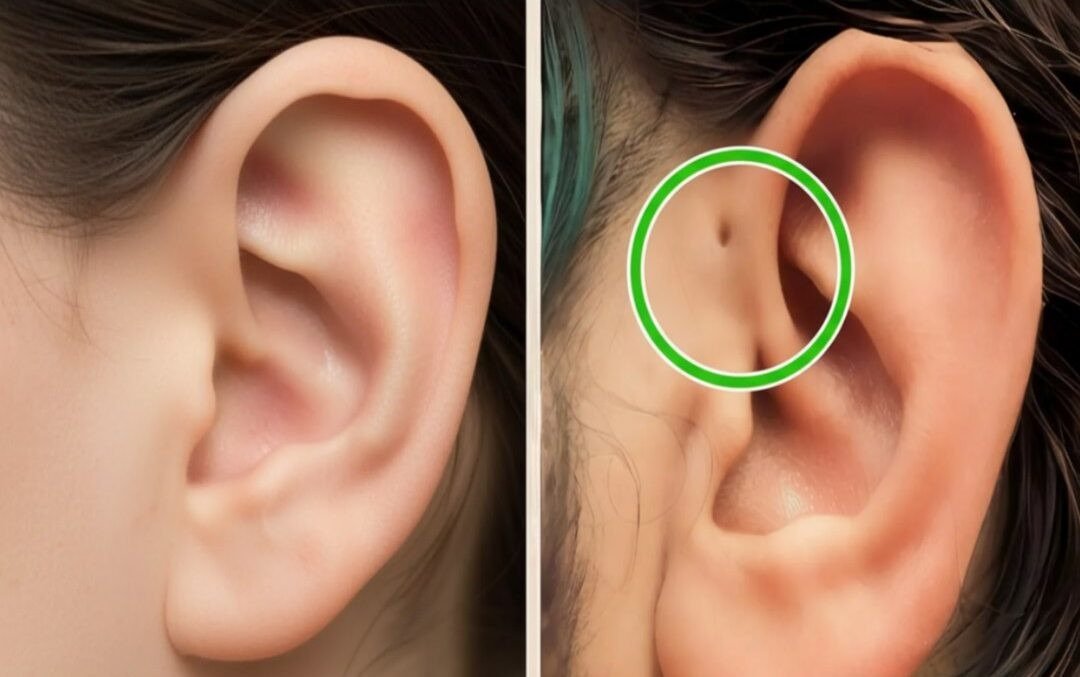
The image shows a side‑by‑side comparison of two ears. The left ear appears normal, while the right ear has a small, dark pit or indentation on the upper cartilage (highlighted with a green circle), commonly called an ear pit or preauricular sinus.
What is an Ear Pit?An ear pit is a tiny congenital opening in the skin of the outer ear, usually near the front of the helix (the upper cartilage). It’s a benign anatomical variation that forms during embryonic development when the ear’s tissues don’t fuse completely. Most ear pits are harmless and asymptomatic.
Characteristics & Implications- Appearance: A small hole or dimple, sometimes with a tiny discharge if it becomes infected.
– Prevalence: Found in about 1% of the population; can be unilateral (one ear) or bilateral (both ears).
– Complications: Rarely, the pit can become infected, causing pain, swelling, or abscess formation. In such cases, medical treatment (antibiotics or drainage) may be needed.
– Treatment: Usually no treatment is required unless infection occurs repeatedly, then surgical removal might be considered.
Clinical SignificanceDoctors often note ear pits during routine exams because they can be associated with other congenital conditions in some cases, though an isolated ear pit is generally insignificant. If you notice redness, swelling, or discharge from an ear pit, consulting an ENT specialist is advisable for proper evaluation.
Bottom LineThe picture illustrates a normal ear next to one with a preauricular sinus (ear pit), a common and usually harmless anatomical feature that only needs attention if infection develops.
