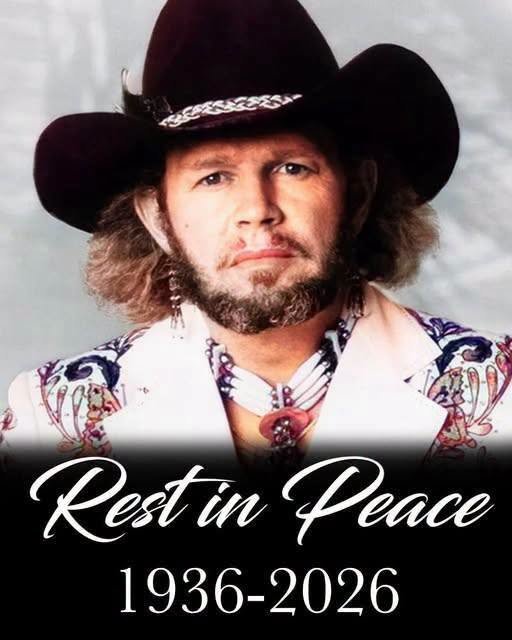
The music world is reeling in stunned silence following the abrupt passing of country music legend David Allan Coe at the age of 86. For decades, he stood as the ultimate outsider, a man whose life was as jagged, unpredictable, and raw as the songs he penned. His death has arrived not with the fanfare of a grand farewell, but with a chilling lack of clarity—no immediate cause of death, no final public statement, and no closure for a fanbase that spent years trying to reconcile his undeniable genius with his deeply polarizing and often offensive reputation.
Coe’s journey to the center of the country music scene began not in the polished halls of Nashville, but in the harsh, unforgiving margins of society that he never truly left. His origin story was not just a promotional narrative; it was the bedrock of everything he produced. Having spent significant portions of his early life navigating the brutal reality of the prison system, Coe brought an authenticity to the outlaw country movement that others could only attempt to emulate. His music was not designed for the comfort of the radio-friendly listener; it was unfiltered, jagged, and sounded less like a performance and more like a whispered confession delivered in the smoke-filled, dimly lit corners of a dive bar.
For many, this brutal honesty was a form of catharsis. He captured the essence of the forgotten, the broken, and the rebellious, turning the pain of his lived experience into anthems that resonated with those who felt alienated from the mainstream. There was a time when Coe was viewed as a vital, if dangerous, voice of a specific brand of American grit. Yet, that same commitment to living on the edge led him into dark territories that left an indelible, ugly stain on his public image. His career was frequently derailed and defined by his more extreme, hateful, and inflammatory creative output—work that created a permanent, widening divide among his audience.
His death serves as an uncomfortable punctuation mark at the end of a sentence that was already difficult to read. There is no final resolution to the tensions he created during his lifetime; there is only a freezing of that tension in time. His legacy is now trapped in a permanent state of flux, where his contributions to the outlaw country canon exist in direct, violent opposition to his personal controversies. The records are still spinning, the live tapes are still being traded, and the barroom legends are still circulating, but the man himself is no longer there to justify or defend his actions.
This is a legacy defined not by consensus, but by deep, unresolved contradiction. He was an artist who could provoke profound reflection in one breath and incite genuine fury in the next. To view him simply as an “outlaw” is to ignore the harmful impact of his choices, yet to dismiss him entirely as an “outcast” is to overlook the raw talent that made him a significant figure in music history. He was both, and perhaps he was neither. He remains an unsettled entity in the archives of American culture, a figure whose presence continues to stir debate, discomfort, and fascination.
Perhaps the most accurate way to remember him is as a man who thrived on being impossible to categorize. He lived life on his own terms, for better or for worse, and he demanded that his audience reconcile with the entirety of his existence. As the tributes roll in and the retrospective pieces are written, we are reminded that some legacies are never meant to be cleaned up or polished for posterity. Some lives, like David Allan Coe’s, are destined to remain jagged, raw, and fundamentally unsettled long after the music stops playing.
In the end, his passing leaves us exactly where we were when he was alive: staring at a complicated, broken mirror of a man who changed the landscape of country music without ever truly finding his place within it. We are left to decide what we can overlook, what we must condemn, and what we can acknowledge. His death hasn’t solved the mystery of David Allan Coe; it has only solidified his place as the most enduring, problematic, and irrepressible outlaw the genre has ever known. Whether you find his influence profound or abhorrent, one thing is certain: his absence is now just as loud as his presence once was, leaving us to navigate the silence of an icon whose life was never meant to be easy, and whose death is far from peaceful.
Listeners are now forced to confront the same question that shadowed his entire career: How much of an artist can you separate from the art? For a generation of fans, Coe’s music is inseparable from their own personal memories, yet for many others, his name has become synonymous with the exact prejudices that the genre has fought so hard to overcome. He sits in a liminal space between genuine admiration and total rejection, an uncomfortable middle ground that refuses to be simplified or ignored. His influence on country music is undeniable, yet it remains fundamentally tainted by the choices he made off the stage and, at times, directly on it.
