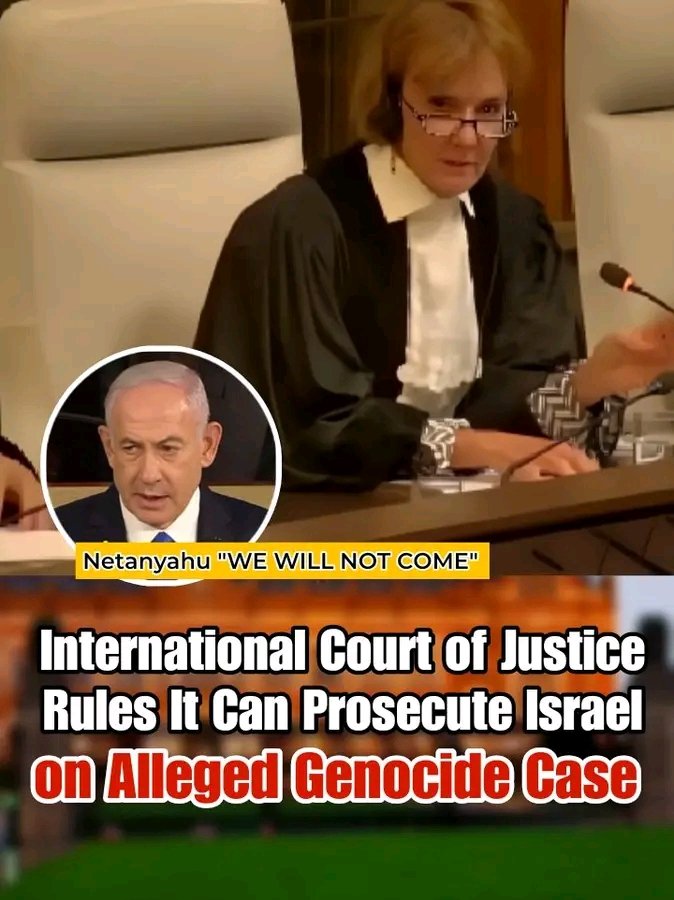
The image provided is a digital graphic referencing the ongoing legal proceedings at the International Court of Justice (ICJ) regarding South Africa’s genocide case against Israel.
The graphic features Judge Joan Donoghue (who was President of the ICJ at the time of the initial 2024 ruling) and an inset of Israeli Prime Minister Benjamin Netanyahu with the quote “We will not come.”
Fact-Checking the Headlines
To understand the current state of this case in 2026, it is important to distinguish between the inflammatory social media framing and the actual legal reality.
1. “International Court of Justice Rules It Can Prosecute Israel”
This is a simplified interpretation of the court’s jurisdictional ruling. In January 2024, the ICJ ruled that it has the jurisdiction to hear the case, meaning the lawsuit was not dismissed and will proceed to a full trial.
The Reality: The ICJ does not “prosecute” individuals (that is the role of the International Criminal Court, or ICC). Instead, the ICJ settles disputes between states.
The Status: As of April 2026, the case is still in the “merits” phase. South Africa filed its full evidentiary memorial in late 2024, and the deadline for Israel’s formal counter-memorial was recently set for March 2026.
2. Netanyahu: “We Will Not Come”
This quote is often used in social media memes to suggest Israel is boycotting the court.
The Context: While Netanyahu has been fiercely critical of the ICJ, calling the case “outrageous,” Israel did sent a high-level legal team to The Hague to defend itself during the preliminary hearings.
The Sentiment: The quote likely refers to Netanyahu’s January 2024 statement: “No one will stop us—not The Hague, not the Axis of Evil, no one.” It signaled political defiance rather than a total legal withdrawal from the proceedings.
The Legal Timeline: 2024–2026
The case has evolved significantly over the last two years:
Date Key Event
Jan 26, 2024 The ICJ issued provisional measures, ordering Israel to prevent genocidal acts and allow more aid into Gaza. It found it “plausible” that Palestinian rights under the Genocide Convention were at risk.
May 24, 2024 The Court issued a more specific order for Israel to “immediately halt” its military offensive in Rafah due to the risk to civilians.
Oct 2025 Several nations, including Ireland, Spain, and Chile, formally intervened in the case to support South Africa’s legal arguments.
March 2026 Fiji, Hungary, Namibia, and the United States filed interventions. The U.S. and Hungary argued for a “high threshold” of proof for genocidal intent, while Namibia argued intent could be inferred from the scale of destruction.
Current Situation (April 2026)
The case is currently in a “paper phase” where both sides submit thousands of pages of evidence. A final verdict—determining whether genocide actually occurred—is not expected for several more years.
In the meantime, the ICJ remains a diplomatic battleground. While its rulings are legally binding, the court has no police force to enforce them, relying instead on the UN Security Council and international pressure to ensure compliance.
Note on the Image: The woman pictured is Judge Joan Donoghue, an American jurist. She retired from the ICJ in February 2024 and was succeeded as President by Judge Nawaf Salam of Lebanon. Use of her image in 2026 usually refers back to the original “plausibility” ruling she delivered.
