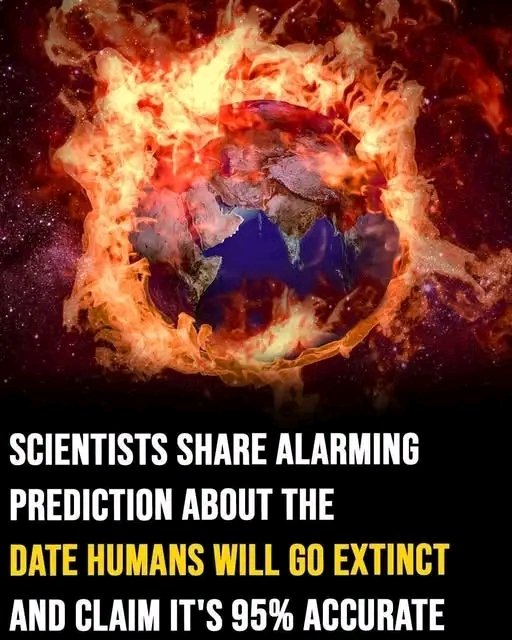
3 things to know about posts like this:
1. Science doesn’t predict exact extinction dates
Extinction risk is studied as probabilities, scenarios, and timescales — not calendar dates. Groups like the IPCC, World Economic Forum, and academic risk researchers talk about climate tipping points, biodiversity loss, and existential risks. They use ranges like “by 2050” or “this century” for specific impacts like sea-level rise or heatwaves. They don’t, and can’t, calculate “humans go extinct on X date with 95% accuracy.” That would require predicting every war, disease, technology, and asteroid for thousands of years. No model can do that.
2. The “95% accurate” number is a red flag
95% accuracy is language from machine learning or product testing, not from extinction science. When you see a precise percentage + exact date + fear imagery, it’s usually a clickbait graphic, not a peer-reviewed paper. Real studies cite journals, authors, and methods. They don’t use ALL-CAPS + fire backgrounds.
3. Real risks scientists are studying
Researchers do study serious threats to human survival:
– Climate change: More heatwaves, crop stress, sea-level rise. IPCC reports project impacts but not human extinction.
– Nuclear risk, pandemics, AI alignment, asteroids: These are called “existential risks.” Organizations like Future of Humanity Institute and Global Challenges Foundation model them to reduce risk, not to set dates.
– Biodiversity loss: Species are going extinct faster than normal, but “human extinction” is a separate, much lower-probability scenario.
Why this graphic spreads
Fear + certainty + a deadline gets clicks. The burning Earth image is a visual metaphor used for climate change, not literal flames. But pairing it with a fake “date” turns a real discussion into misinformation.
What to do if you see this:
1. Check if a real study is linked. No link = no verification.
2. Search the exact quote + “Snopes” or “Reuters Fact Check”. Viral extinction-date claims have been debunked many times.
3. Go to primary sources: IPCC reports, National Academies, or university press releases if it’s real research.
Bottom line: Humanity faces real challenges, and scientists are working on them. But no credible scientist has announced a 95% accurate extinction date. The future isn’t fixed — it depends on choices we make now about energy, health, and cooperation.
